NCAA Core Courses Guide 2026: 16 Units You Need To Play College Sports
The NCAA Core Courses requires these specific high school classes to count toward your academic eligibility properly. You absolutely need exactly 16 units to qualify for Division I and Division II sports in the 2026 athletic season.
Meeting these strict standards ensures you become a full qualifier with an athletic scholarship. This status grants you permission to practice, travel, and compete alongside your fellow freshman student-athletes without facing any early restrictions.
Also, tracking your Core GPA over exactly 32 semesters sets clear expectations for college. If you fall short, you might face Academic Redshirt limitations or become one of the restricted Partial Qualifiers right away today.
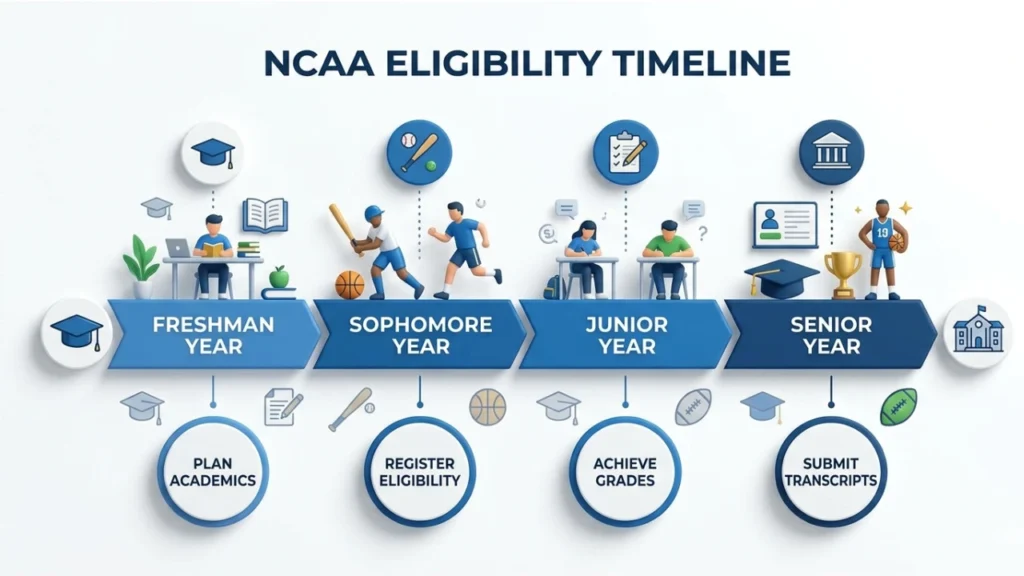
You must finish your approved courses following a strict timeline to meet amateurism rules. Your participation heavily relies upon the Eligibility Center verifying your enrollment and evaluating all completed subject areas accurately starting right today.
Submitting an official transcript early streamlines modern recruiting discussions. Always check official sources and ask your agent to confirm latest numbers because having an exact core course requirement record matters so very deeply.
What Exactly Is An NCAA Core Course?
An NCAA-approved class provides instruction at a strict academic level by a qualified instructor. It must appear on your school’s list and feature proper pacing leading up to your ultimate high school graduation day milestones.
You must study preparatory subjects like English, Math, Science, Social Science, or a World Language. These 16 core courses establish the foundation the Eligibility Center demands before granting you clearance to properly play college sports.
| Category | Specific Requirement (NCAA 2026) |
|---|---|
| Minimum GPA | 2.3 (Division I) / 2.2 (Division II) |
| Core Units | 16 Units (English, Math, Science, etc.) |
| SAT/ACT Score | 0 (Not required for eligibility) |
| Timing (10/7 Rule) | Must complete 10/7 units before the 7th semester |
Courses like English 1-4, American literature, and Creative Writing count successfully. For mathematics, you need classes like Algebra I or higher, including Algebra 1-3, Geometry, or Statistics to fulfill all those necessary core academic credits.
Your lab science requirements usually feature Biology, Chemistry, and Physics. Plus, exploring deep historical concepts through American History, Civics, or standard Government classes fulfills your core social studies obligations without any unnecessary or extra stress.
Options like Spanish 1 to 4, Comparative Religion and philosophical studies like Philosophy also apply. Keep in mind, finding your exact class on that official portal guarantees it meets the rigorous expectations set by the high administrators.
The 16 Core Course Breakdown (DI Vs. DII)
Here is the thing: both major divisions demand exactly 16 core courses, but their distributions differ slightly. For Division I, you need 4 years of English alongside 3 years of math starting with Algebra 1.
You must also finish 2 years of natural or physical science, including one actual lab science. Then, add exactly 1 extra year of English, math or science to strengthen your overall academic profile for recruiters.
Next comes 2 years of social science and 4 additional years of any approved subjects like a world language, comparative religion, or philosophy. These round out your schedule perfectly before entering your new big university.
Meanwhile, Division II requires 3 years of English and only two years of math. You still need two years of science, but you take 3 extra years of English, math, or science classes right now.
Both paths require proper academic certification upon completion. Understanding this breakdown helps you choose classes wisely each semester, ensuring you remain eligible to play without constantly worrying about missing a single required high graduation credit.
The “10/7” Progression Rule (Most Important For Rankings)
This major Progression Rule applies strictly to Division I prospects. A student must complete exactly 10 core courses before beginning their senior year which officially marks the start of their highly anticipated 7th semester.
Out of those ten early classes, seven must be in English, math, or science. Your grades from your junior year and earlier become permanently locked in and cannot be effectively replaced or improved later on.
If you fail a core course, you must repeat it before that semester begins to earn credit. You can only retake it once to safely secure a higher grade before the final strict deadline hits.
This rule prevents academic mistakes from ruining your chances late in the game. Earning low grades early means you must actively monitor your academic progress to keep your very best college options safely wide open.
High school counselors strongly suggest you register early to avoid surprises. Consistent performance in your education prevents scrambling during those final months when you should be focusing on sports and fun campus visits very happily.
Which Courses Do NOT Count? (Avoid These Traps)
Many fun electives fall into the Non-core category and do not help your eligibility. Classes like driver’s ed, typing, art, music and PE are fantastic for personal growth but useless for clearing mandatory NCAA requirements.
Similarly, hands-on trades like welding, vocational, and technical training courses do not count either. Even practical life skills like personal finance or consumer education get rejected unless they teach rigorous algebraic core mathematical design concepts.
Be cautious with any tech prep or sub-grade level classes. Courses labeled as basic, essential, fundamental, or remedial simply lack the necessary academic rigor and will quickly derail your journey toward actual college student athletics.
Extracurricular writing activities example Advanced Journalism, Spirit, and Yearbook might look great on general college applications. Still, they will not boost your core tally, so prioritize standard English classes to stay perfectly academically secure today.
Also, some Nontraditional formats such as online, distance learning, hybrid, or blended models face strict scrutiny. Ensure your independent study or individualized instruction meets rules for instructor-led interaction, evaluation, and consistent daily virtual academic learning assistance.
Calculating Your NCAA Core GPA
Your core course GPA calculation uses these approved classes. For D1, you need a 2.3, while D2 requires a 2.2. Securing exactly 4 units across your final 8 semesters ensures better long term academic standing now.
They use your official transcript and your high school code (like 160140) to accurately track progress. They map grades onto a four-point scale, meaning an A earns four points and a D earns only one.
To ensure you stay above the required threshold for Division I or II then you can use our online grade calculator to accurately track your progress across all 16 core units.
Do not include electives or health class grades in this math. Why this matters: you could have a 3.5 overall GPA but fail because your core numbers sit too low for proper initial enrollment clearance.
You should use the GPA calculator inside our Academic Tools section to track performance. If you take classes during ninth grade, or eighth grade like Spanish I, these will directly impact your final athletic grade.
Remember, enrolling in summer courses helps boost numbers before strict deadlines. A higher grade updates your calculation positively, improving your exact odds under the sliding scale alongside your recently submitted official standardized test scores directly.
Guidelines For Canadian & International Students
Canadian students tracking D1 or D2 must check international guides. Earning a full unit, 0.5 units or 4 units across 8 semesters abroad requires careful attention to verify your initial eligibility safely without risking any frustrating athletic paperwork delays today.
A Canadian college transcript requires completely separate review. To stay on time for your first eight semesters, review your academic year plan and ensure your core-course progression matches up with the 10/7 requirement absolutely perfectly today.
International students pursuing full-time enrollment at an American university must accurately translate their percentage grades into letter equivalents. The portal provides calculators for this conversion, ensuring a seamless transition into collegiate sports programs easily abroad.
If you study abroad, remote classes involve emails, chats, phone calls, and direct feedback on assignments. The NCAA mandates a defined time period for completion to maintain the strict integrity of their rigorous tracking system.
Earning credits globally allows you unlimited potential if documented correctly. If you need a makeup class, ensure your chosen platform or learning module meets core-course legislation before investing time into an unapproved study program today.
Frequently Asked Questions
Q1. Can I take online classes?
Yes, through an approved curriculum. Programs used for Credit Recovery or Retaking a class must provide actual teaching in a virtual classroom within a specific strict daily time frame safely.
Q2. What if I fall behind in 16 core course requirements?
You miss practices, games, and travel. Talk to teachers about summer school, tutoring and easily adjusting your study habits to firmly stay on track right now.
Q3. What is the benefit of putting extra effort into difficult subjects?
Better studying in a quiet space builds momentum and a stronger mindset. This extra effort and maturity prevents those non-approved units from dragging down your grades, ensuring your transcript looks completely flawless for college admissions.
Q4. Does the SAT or ACT matter?
Since January 2023, the NCAA paused their standardized test score mandate for initial eligibility. New legislation effective August 1 2023 benefits many college bound prospects safely applying to busy universities nationwide.
Remember, colleges might demand an official transcript. If a class was already retaken, the portal locks the best outcome automatically. The bottom line? Start preparing early, thoroughly consult experts, and securely lock your future collegiate success.